Skip to content
No results
  • About
    • About us
    • How to reach us in Milan
    • How to reach us in Merate
    • Photos library
    • Contacts
      • Contacts OAB
      • Telephone E-mail
      • Services
  • Research
    • Research activities
    • Scientific and technological projects
    • Publications
    • Report
    • Seminars
    • Funding
    • Thesis
      • Bachelor thesis
      • Master thesis
      • PhD thesis
      • Old students
    • Astronomical Links
  • Library and historical archive
  • Outreach
    • Visit the Observatory
    • School activities
    • Museo Astronomico di Brera
  • News
    • Scientific news
    • Outreach news
    • Gender issues (for the staff)
  • Work with us
  • Transparent administration
  • For staff only
  • English
  • Italian
INAF Osservatorio Astronomico di Brera
INAF-Osservatorio Astronomico di Brera
  • About
    • About us
    • How to reach us in Milan
    • How to reach us in Merate
    • Photos library
    • Contacts
      • Contacts OAB
      • Telephone E-mail
      • Services
  • Research
    • Research activities
    • Scientific and technological projects
    • Publications
    • Report
    • Seminars
    • Funding
    • Thesis
      • Bachelor thesis
      • Master thesis
      • PhD thesis
      • Old students
    • Astronomical Links
  • Library and historical archive
  • Outreach
    • Visit the Observatory
    • School activities
    • Museo Astronomico di Brera
  • News
    • Scientific news
    • Outreach news
    • Gender issues (for the staff)
  • Work with us
  • Transparent administration
  • For staff only
  • English
  • Italian
INAF Osservatorio Astronomico di Brera
INAF-Osservatorio Astronomico di Brera
  • News, Scientific news

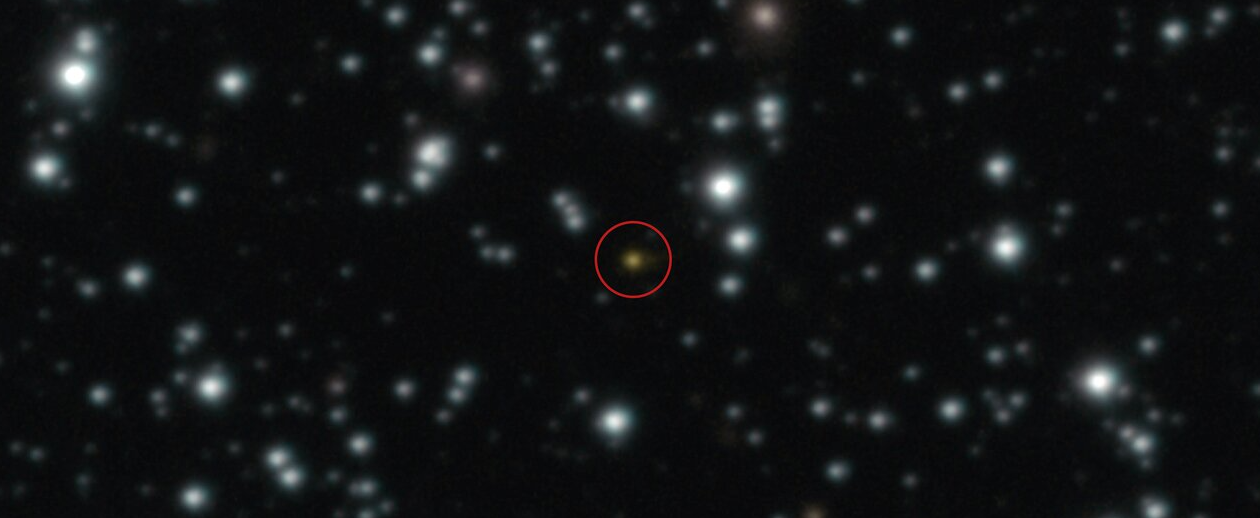
Double detonation: new image shows remains of star destroyed by pair of explosions – ESO Press Release

This image, taken with ESO’s Very Large Telescope (VLT), shows the supernova remnant SNR 0509-67.5. These are the expanding remains of a star that exploded hundreds of years ago in a double-detonation – the first photographic evidence that stars can die with two blasts. The data were captured with the Multi-Unit Spectroscopic Explorer (MUSE) instrument at the VLT. MUSE allows astronomers to map the distribution of different chemical elements, displayed here in different colours. Calcium is shown in blue, and it is arranged in two concentric shells. These two layers indicate that the now-dead star exploded with a double-detonation - Credit: ESO/P. Das et al. Background stars (Hubble): K. Noll et al.
  • 2 July 2025
  • Gender issues, News

June 19, 2025 – An LGBTQIA+ Bench in Merate

Le varie fasi della lavorazione della panchina arcobaleno
  • 20 June 2025
  • News, Scientific news

Astronomers capture most detailed thousand-colour image of a galaxy – ESO Press Release

This image shows a detailed, thousand-colour image of the Sculptor Galaxy captured with the MUSE instrument at ESO’s Very Large Telescope (VLT). Regions of pink light are spread throughout this whole galactic snapshot, which come from ionised hydrogen in star-forming regions. These areas have been overlaid on a map of already formed stars in Sculptor to create the mix of pinks and blues seen here - Credit: ESO/E. Congiu et al.
  • 18 June 2025
  • Gender issues, News

June 11, 2025 – Inauguration of our Rainbow Bench!

Locandina inaugurazione della panchina arcobaleno - INAF - OAB - 11 giugno 2025
  • 13 June 2025
  • News, Scientific news

Telescope that saw “Martians” restored – Media INAF

Il rifrattore Merz dell’Inaf di Brera, prima, durante e dopo il restauro. Crediti: Laura Barbalini/Inaf Brera
  • 12 June 2025
  • News, Scientific news

In Brera, celestial maps and terrestrial maps – Media INAF

State of Milan, 1777: at the bottom of the map, in the foreground, a bucolic scene of country leisure but, more in depth, the hard work in the fields
  • 29 May 2025
  • News, Scientific news

“Cosmic joust”: astronomers observe pair of galaxies in deep-space battle – ESO Press Release

This image, taken with the Atacama Large Millimeter/submillimeter Array (ALMA), shows the molecular gas content of two galaxies involved in a cosmic collision. The one on the right hosts a quasar –– a supermassive black hole that is accreting material from its surroundings and releasing intense radiation directly into the other galaxy - Credit: ALMA (ESO/NAOJ/NRAO)/S. Balashev and P. Noterdaeme et al.
  • 26 May 2025
  • Gender issues, News

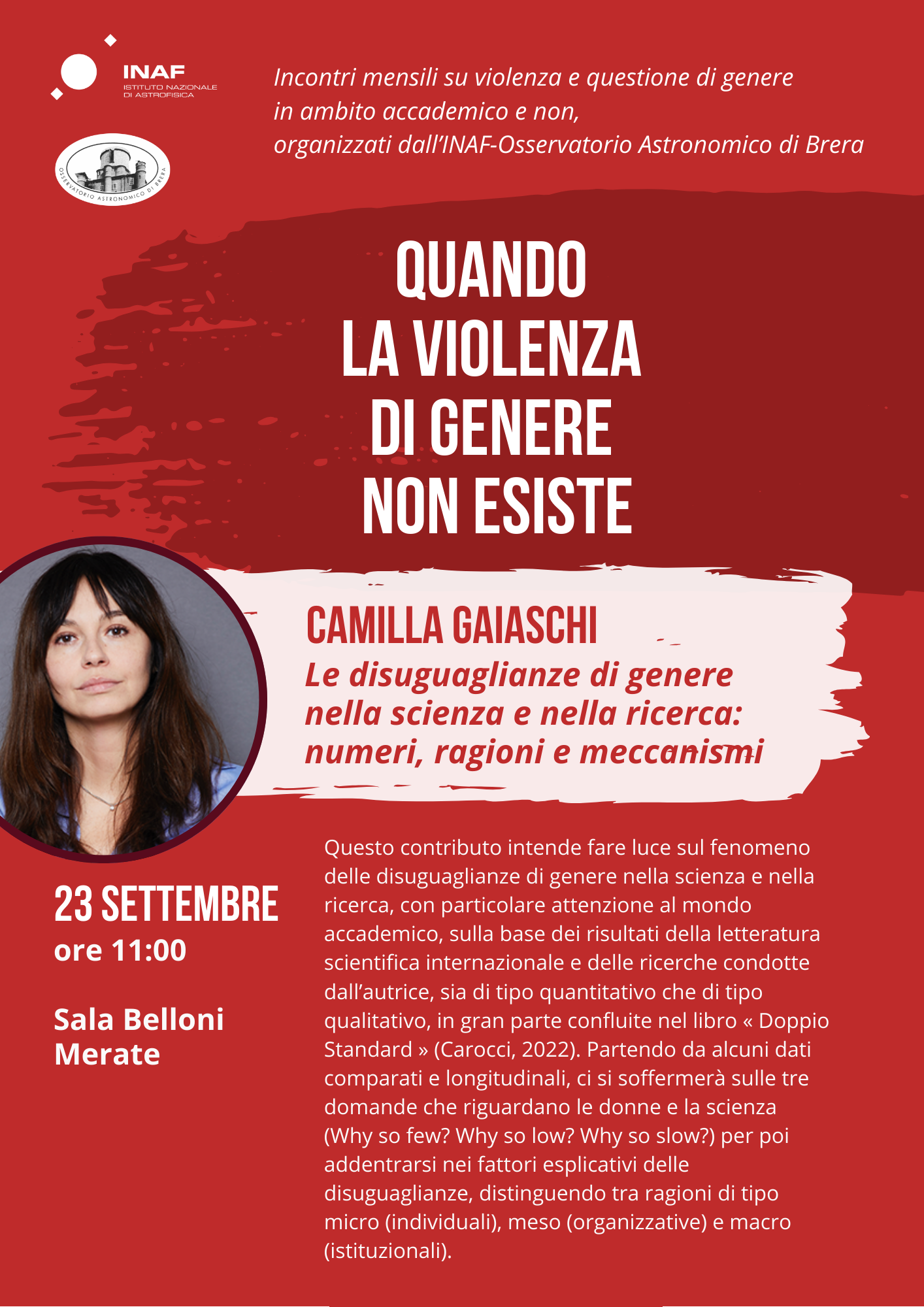
June 4, 2025 – Monthly meetings on violence and gender issues – Fourth meeting with Prof. Marina Calloni

Locandina seminario Prof.ssa Marina Calloni
  • 21 May 2025
  • Gender issues, News

International Day Against Homophobia, Biphobia, Transphobia (May 17th) – Email circulated to the Observatory staff on 16 May 2025

17 maggio - Giornata internazionale contro l'omofobia
  • 20 May 2025
  • News, Scientific news

Equity and inclusion in scientific culture – Media INAF

The poster of the meeting "Beyond the Borders" – May 2025 – Bologna
  • 1 May 2025
  • News, Scientific news

Water planet revealed from the skies of the Canary Islands – Thanks to data collected by the Harps-N spectrograph installed at the TNG – Media INAF

Artist's impression of the icy exoplanet Kepler-10c, observed by the Harps-N spectrograph installed on the Telescopio Nazionale Galileo (TNG). Credits: Inaf
  • 29 April 2025
  • News, Scientific news

Shocking black: shockwaves from stellar black holes – Like the ripples produced by a Stone thrown into a Pond – Media INAF

Artist's impression of a jet emitted by a stellar-mass black hole and the resulting shock wave. Credit: Danielle Futserlaar/Sron
  • 29 April 2025
Prev
1 2 3 4 5 6 7 8
Next

INAF-Osservatorio Astronomico di Brera

via Brera 28
20121 Milano – ITALY

via E. Bianchi 46
23807 Merate (Lc) – ITALY

Codice Fiscale: 97220210583
P.Iva: 06895721006
Codice Univoco: Y9OLR3
pec: inafoamilano@pcert.postecert.it

Info visite
Brera poe.oabr@inaf.it
Merate visiteserali.oabr@inaf.it

Privacy & Cookies Policy

Accessibilità

Seguici su

  • facebook
  • instagram
  • youtube
  • twitter
  • linkedin
  • flickr
  • tiktok

Copyright © 2026 - INAF-Osservatorio Astronomico di Brera

  • English
  • Italiano (Italian)