
Galaxy cluster – Euclid
Phd Thesis
Site: Milano
Duration
3 years
Tutors
Stefano Andreon (INAF-OAB), Marco Landoni (INAF-OAB), Alberto Moretti, Ginevra Trinchieri Alberto Trombetta (UniInsubria) e Mario Radovic (INAF-Pd)
Contact
stefano.andreon AT inaf.it
marco.landoni AT inaf.it
alberto.moretti AT inaf.it
ginevra.trinchieri AT inaf.it
Description
The exceptional point spread function and wide field of view of the Euclid mission is transforming cosmology and galaxy cluster studies by enabling the detection of clusters through weak gravitational lensing shear. This approach bypasses the biases inherent to indirect tracers such as galaxy counts or intracluster medium observables, offering for the first time a largely unbiased view of the cluster population (e.g. Pacaud et al. 2007; Andreon et al. 2016; Orlowski-Scherer et al. 2021). Remarkably, the same Euclid data will provide the astrophysical “holy grail”, cluster mass, for approximately 35,000 galaxy clusters (Andreon & Berge’ 2012).
This PhD project will focus on the analysis of the scaling relations of shear-selected clusters identified in Euclid Data Release 1, within the overlapping footprints of the ACT, SPT, and eROSITA surveys. Through a hierarchical joint SZ/X-ray/weak-lensing analysis, the project will probe both individual cluster properties (such as temperature, pressure, and mass profiles) and population-level trends (including the diversity of cluster properties), while explicitly addressing the selection biases that affect traditional cluster samples.
With DR1 data acquisition now complete and the project formally assigned to Brera by the Euclid Consortium, the work will scale state-of-the-art SZ/X-ray/shear analysis pipelines using Big Data methodologies developed at Brera (Castagna et al. 2022, 2024). The project will deliver a strong scientific return on INAF’s investment in Euclid and establish a methodological framework for forthcoming weak-lensing-driven surveys, including LSST, Rubin and the Roman Space Telescope.
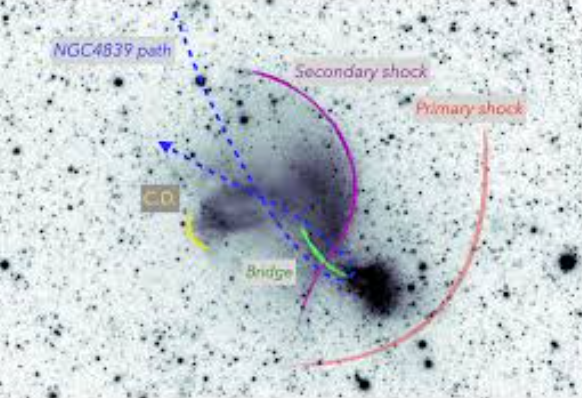
Image: eROSITA view of the intracluster medium of the Coma Cluster [from Churazov et al. 2021].

